Unlike de-essers which target only sibilance, multiband compressors can address any part of the frequency spectrum. This makes them a powerful but potentially dangerous tool in your podcast processing chain.
In This Guide
Main Application
The primary use case for multiband compression in podcasting involves taming harsh high-frequency content. Inexpensive microphones can have uneven response curves in the high end, and when combined with MP3 compression artifacts, this creates an unfavorable listening experience.
Recommended Settings
For high-frequency taming:
| Parameter | Setting |
|---|---|
| Target Range | 8-20 kHz |
| Threshold | -20 dB |
| Ratio | 10:1 |
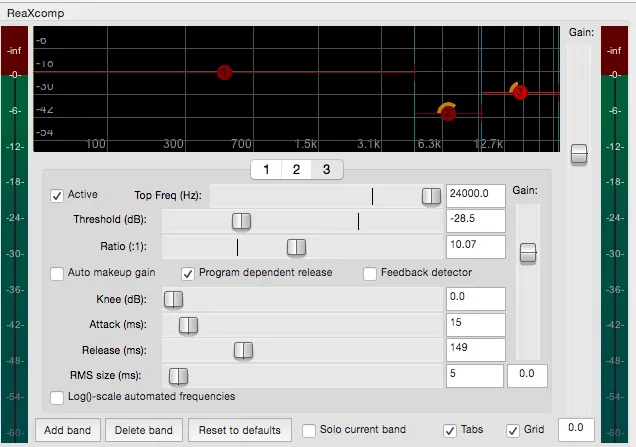
The goal is to smooth out rather than eliminate high-frequency content, preserving natural-sounding audio quality.
Key Recommendations
1. Use Sparingly
Multiband compression requires expertise and should not be applied liberally in podcast workflows. Unlike single-band compression where mistakes are relatively easy to hear, multiband processing can create subtle problems that accumulate and degrade your overall sound.
2. Trust Your Ears
Listeners’ perception matters most. We recommend:
- Taking breaks during editing sessions to reset your ears
- Comparing your work against professional podcast audio for reference
- Listening on multiple playback systems (headphones, speakers, phone)
3. Proper Processing Order
The suggested sequence in your signal chain:
- Standard compressor — Control overall dynamics first (see compression for podcasts)
- De-esser — Target specific sibilance issues (see de-essing guide)
- Multiband compression — Fine-tune remaining problem frequencies
This prevents earlier processing stages from reintroducing frequencies you’re attempting to control.
When to Skip Multiband Compression
Not every podcast needs multiband processing. Consider skipping it if:
- You’re using a quality microphone with smooth frequency response
- Your recording environment is well-treated
- Standard EQ and single-band compression handle your needs
- You’re new to audio processing (master the basics first)
Common Mistakes
- Over-processing — Using too much gain reduction, creating an unnatural sound
- Wrong band selection — Targeting frequencies that don’t need treatment
- Ignoring the rest of the chain — Multiband compression can’t fix problems better solved earlier
- Set and forget — Different voices and episodes may need different settings
Key Takeaways
- Multiband compression is a precision tool for specific problems
- Focus on the 8-20 kHz range for harsh high-frequency content
- Always position after standard compression and de-essing
- Use conservative settings—smooth out, don’t eliminate
- Trust your ears and reference professional audio
Want professional audio processing without the complexity? If mixing and mastering isn’t where you want to spend your time, Podigy handles the entire post-production process.