

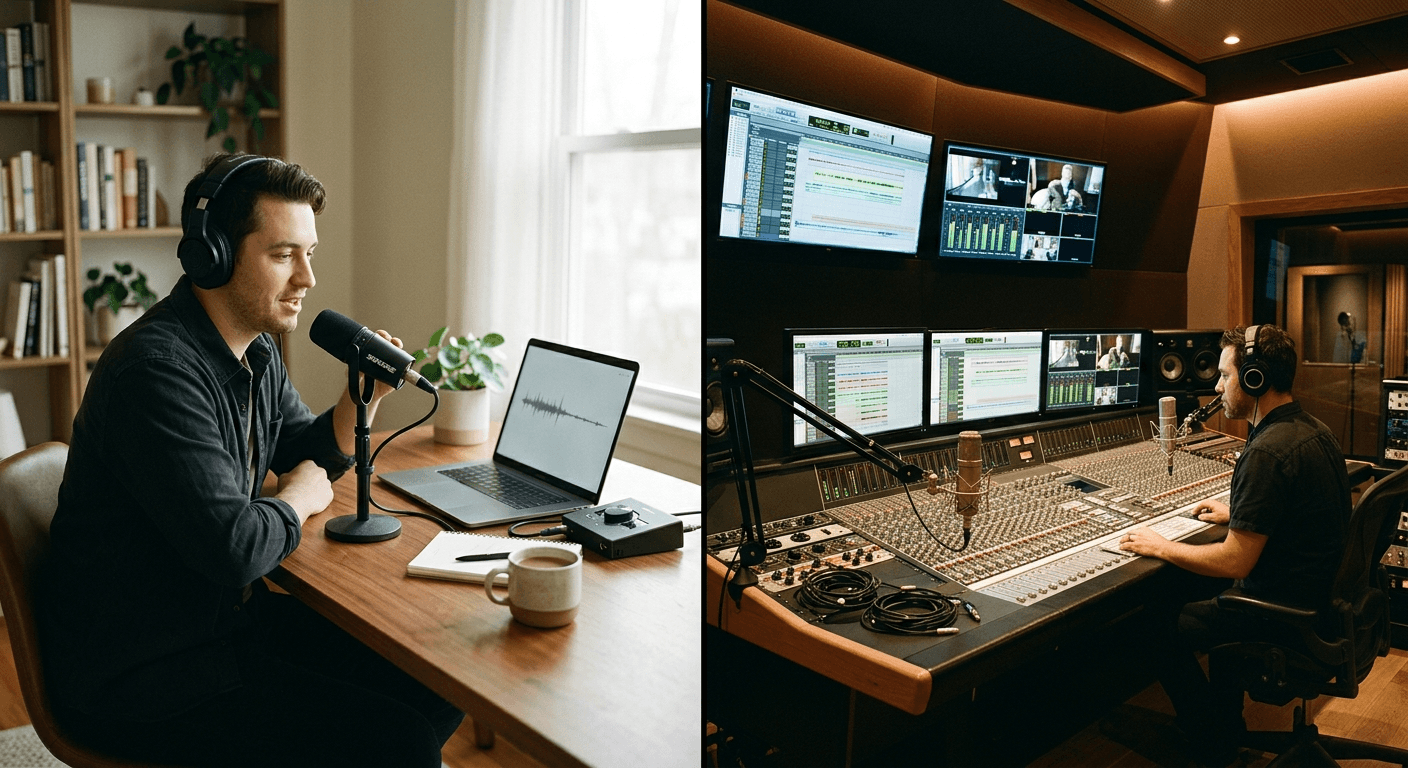
Every B2B company that commits to podcasting faces the same decision: build an internal production team or hire an outside partner. Both models work. Both have trade-offs. The right choice depends on your volume, budget, and what you’re optimizing for.
This guide lays out the real comparison — not the one that conveniently concludes “hire us.” We’ll cover actual costs, time investments, and the scenarios where each model wins.
In This Guide
The Real Comparison
| Factor | In-House | Outsourced (Agency) |
|---|---|---|
| Year 1 cost | $68,000–$161,000 | $30,000–$90,000 |
| Ongoing annual cost | $65,000–$130,000 | $30,000–$90,000 |
| Time to first episode | 4–8 weeks (hiring + setup) | 2–3 weeks |
| Your team’s time/week | 10–16 hours | 1–4 hours |
| Quality floor | Depends on hire | Established baseline |
| Flexibility | High (full control) | Medium (within scope) |
| Risk if key person leaves | High (single point of failure) | Low (team-based) |
| Strategic guidance | Only if you hire for it | Typically included |
In-House: The True Cost
Salary and Benefits
A podcast producer who can handle the full production workflow — recording, editing, mixing, show notes, clips, distribution — is a specialized role. Here’s what the market pays:
| Role | Salary Range | Fully Loaded Cost (benefits, taxes, overhead) |
|---|---|---|
| Junior podcast producer | $45,000–$55,000 | $58,000–$72,000 |
| Mid-level producer/editor | $55,000–$75,000 | $72,000–$98,000 |
| Senior producer (strategy + production) | $75,000–$100,000 | $98,000–$130,000 |
“Fully loaded” means salary + benefits (healthcare, PTO, retirement) + employer taxes + overhead (desk, equipment, software). The rule of thumb: multiply base salary by 1.3x.
Equipment and Software (Year 1)
| Category | Cost |
|---|---|
| Recording equipment (mics, camera, lights) | $2,000–$8,000 |
| Editing workstation | $1,500–$3,000 |
| Software licenses (DAW, recording platform, design tools, hosting) | $1,200–$3,000/year |
| Acoustic treatment | $500–$2,000 |
| Total Year 1 Setup | $5,200–$16,000 |
Year 1 Total: In-House
| Component | Low End | High End |
|---|---|---|
| Producer salary (fully loaded) | $58,000 | $130,000 |
| Equipment and software | $5,200 | $16,000 |
| Recruiting costs (agency fee or time) | $5,000 | $15,000 |
| Training and ramp-up (2–3 months of reduced output) | Included in salary | Included in salary |
| Year 1 Total | $68,200 | $161,000 |
The Hidden In-House Cost: Management Overhead
Your podcast producer needs a manager. Someone needs to:
- Set quarterly content strategy
- Review and approve episodes before publishing
- Coordinate with sales for guest suggestions
- Manage the producer’s workload and career growth
- Cover production when they’re sick or on vacation
- Handle equipment issues and software updates
This isn’t a full-time job, but it’s 3–5 hours per week of a marketing leader’s time. At $80–$120/hour for a VP of Marketing or Content Director, that’s $12,000–$30,000/year in management overhead that never shows up in a budget spreadsheet.
Outsourced: The True Cost
Agency Pricing
Full-service B2B podcast agencies charge between $2,500 and $15,000+ per month. For a detailed breakdown of what each tier includes, see our B2B podcast production cost guide.
| Tier | Monthly | Annual |
|---|---|---|
| Growth (editing + basic distribution) | $2,500 | $30,000 |
| Professional (full production + strategy) | $4,500–$7,500 | $54,000–$90,000 |
| Premium (multi-format, dedicated team) | $7,500–$15,000 | $90,000–$180,000 |
What’s Included That You’d Otherwise Build
An agency fee bundles costs that would be separate line items in-house:
- Editor salary — you’re sharing a senior editor across the agency’s client base, which is more cost-efficient than hiring one full-time
- Software and tools — DAW, recording platform, design tools, analytics
- Equipment — the agency maintains their own production environment
- Backup coverage — if your editor is unavailable, another team member steps in
- Strategic expertise — years of pattern recognition across dozens of B2B shows
- Process and systems — file management, QA workflows, delivery pipelines
What’s Not Included
- Your time for recording (unavoidable in any model)
- Your time for review and feedback (1–2 hours/week)
- Your team’s involvement in strategy sessions (monthly, 1 hour)
Time Comparison: Where Your Hours Go
This is the comparison most people skip, and it’s often the deciding factor.
In-House: Your Team’s Weekly Time
| Task | Hours/Week |
|---|---|
| Managing the producer | 3–5 |
| Content strategy and topic planning | 2–3 |
| Recording episodes | 1–2 |
| Reviewing edits and providing feedback | 2–3 |
| Guest coordination and scheduling | 1–2 |
| Approving social clips and assets | 1 |
| Total team time | 10–16 hours/week |
Even with a full-time producer, your marketing team spends 10–16 hours per week on podcast-related tasks. The producer handles production; your team handles strategy, quality control, and management.
Outsourced: Your Team’s Weekly Time
| Task | Hours/Week |
|---|---|
| Recording episodes | 1–2 |
| Reviewing delivered edits | 30–60 min |
| Monthly strategy call | 15 min (amortized) |
| Approving social clips | 15–30 min |
| Total team time | 2–4 hours/week |
The agency handles strategy, production, distribution, and analytics. Your team records and reviews. That’s a 75% reduction in weekly time commitment.
Time Savings in Dollar Terms
| Role | In-House Hours/Week | Outsourced Hours/Week | Hours Saved | Value at $100/hr |
|---|---|---|---|---|
| Marketing Director | 5 | 1 | 4 | $20,800/year |
| Content Manager | 8 | 2 | 6 | $31,200/year |
| Host (executive) | 3 | 2 | 1 | $5,200/year |
| Total | 16 | 5 | 11 | $57,200/year |
Those reclaimed hours don’t disappear — they go to other marketing activities, sales enablement, or strategic work.
Quality and Consistency
In-House Quality
Pros:
- Complete creative control
- Deep brand knowledge over time
- Can iterate quickly on feedback
- Producer learns your industry deeply
Cons:
- Quality ceiling is limited to one person’s skills
- No external benchmark — hard to know if quality is “good enough”
- Skill gaps (a great editor may not be a great strategist, or vice versa)
- Quality drops during transitions (vacation, sick days, turnover)
Outsourced Quality
Pros:
- Established quality baselines from working across many shows
- Pattern recognition — the agency has seen what works across dozens of B2B podcasts
- Specialized roles (separate editors, strategists, designers)
- Consistent output even during individual team changes
Cons:
- Less brand intimacy than an embedded team member
- Communication latency (requests go through account management)
- Revision cycles may be slower than walking to your producer’s desk
- Agency priorities may shift if they take on larger clients
The Consistency Factor
Consistency is the most underrated factor in podcast production. Your audience expects the same quality every week. One person getting sick shouldn’t mean a skipped episode or a noticeably worse edit.
In-house, you’re one resignation letter away from a production gap. The average tenure of a media producer at a B2B company is 18–24 months. Each departure means 2–4 months of recruiting, onboarding, and ramp-up during which quality and consistency suffer.
Agencies absorb this risk. When a team member leaves, the systems, templates, and processes remain. The transition is internal to the agency, invisible to you.
Scaling: What Happens When You Grow
Scaling In-House
Going from 1 episode/week to 2 episodes/week in-house usually means:
- Hiring a second producer ($58,000–$98,000 fully loaded)
- More equipment
- More management overhead
- Potentially a dedicated studio space
Cost increase: 50–80% for a 100% output increase. The economics improve with scale, but the step function is steep.
Scaling Outsourced
Going from 1 episode/week to 2 episodes/week with an agency usually means:
- Moving up a pricing tier or adding a second show package
- Same relationship, same systems, same quality
Cost increase: 40–60% for a 100% output increase. Agencies achieve this because they already have the infrastructure — adding volume to an existing production pipeline is cheaper than building a second one.
The Hybrid Model
Some companies split the difference:
In-house strategy + outsourced production:
- Your team owns content strategy, guest booking, and brand direction
- The agency handles all post-production, distribution, and optimization
- Best of both worlds: strategic control without production overhead
In-house production + outsourced strategy:
- Your producer handles editing and daily production
- An agency provides quarterly strategy, analytics audits, and optimization guidance
- Works when you have a strong producer but lack podcast-specific strategic expertise
The hybrid model often costs 60–70% of full in-house while maintaining most of the strategic control.
Decision Framework
Choose In-House When:
- Volume justifies a full-time hire — 3+ episodes per week across multiple shows
- Deep industry expertise is required — regulated industries where the editor needs domain knowledge (pharma compliance, legal review)
- Real-time iteration matters — live shows, rapid turnaround requirements under 24 hours
- Budget allows for redundancy — you can afford 2+ producers to avoid single-point-of-failure risk
- You’re building a media brand — the podcast is the product, not a marketing channel
Choose Outsourced When:
- Your team’s time is the bottleneck — marketing leaders spending 10+ hours/week on production tasks
- You want pipeline results, not just content — the strategy layer matters as much as the production
- 1–2 episodes per week — not enough volume to justify a full-time hire
- Consistency is critical — you can’t afford production gaps
- You want to launch fast — agencies can be producing within 2–3 weeks vs. 4–8 weeks for hiring
The Tipping Point
In-house becomes more cost-effective than outsourcing at roughly 6–8 episodes per month across 2+ shows. Below that, the overhead of a full-time hire (benefits, management, equipment, backup coverage) makes outsourcing more efficient.
Above 8 episodes per month, the math shifts — but only if you can hire and retain strong talent, which in the podcast production space isn’t guaranteed.
Common Mistakes in Both Models
In-House Mistakes
- Hiring a generalist — “our marketing coordinator can figure out the podcast” leads to mediocre quality and burned-out employees
- No backup plan — when your one producer is unavailable, production stops
- Underestimating equipment costs — budgeting for a mic but not acoustic treatment, lighting, or a proper editing workstation
- Skipping strategy — hiring an editor without a content strategist means producing content that sounds good but doesn’t drive business outcomes
Outsourcing Mistakes
- Choosing on price alone — the cheapest agency often means rotating editors, slow turnaround, and template-based “strategy”
- Not verifying the dedicated editor model — ask: “Will I have the same editor every week?” If the answer is anything other than yes, think twice
- Expecting zero involvement — even full-service agencies need 2–4 hours/week of your time for recording and review
- Not aligning on metrics — define what success looks like (downloads? leads? meetings booked?) before signing a contract
FAQ
Can I start outsourced and move in-house later?
Yes, and this is actually a smart path. Working with an agency first teaches you what good production looks like, what tools and processes matter, and what your audience responds to. When you do hire internally, you’ll know exactly what to look for and how to manage the role.
What if I have a small marketing team?
Outsourcing is almost always the right call for teams under 5 people. Your team’s time is too valuable to spend on production tasks. Focus on creating great content during recording; let the agency handle everything after you hit “stop.”
How do I evaluate an agency’s quality before signing?
Ask for 3 things: (1) samples from current B2B clients in a similar space, (2) a reference call with a current client, and (3) a clear description of their editing workflow. A strong agency will happily provide all three. If they hesitate on client references, that tells you something.
What about using AI tools to reduce in-house costs?
AI tools (Descript, Adobe Podcast, etc.) can reduce editing time by 20–40% for basic cuts. They don’t replace the human judgment needed for pacing, narrative flow, or quality control. They also don’t handle strategy, distribution, or optimization. AI is a productivity multiplier for skilled editors, not a replacement. For a full comparison, see our podcast software guide.
Podigy handles the entire post-production process for B2B podcasts. Same dedicated editor every week. 5 business day turnaround. See what’s included or book a strategy call to discuss your situation.