

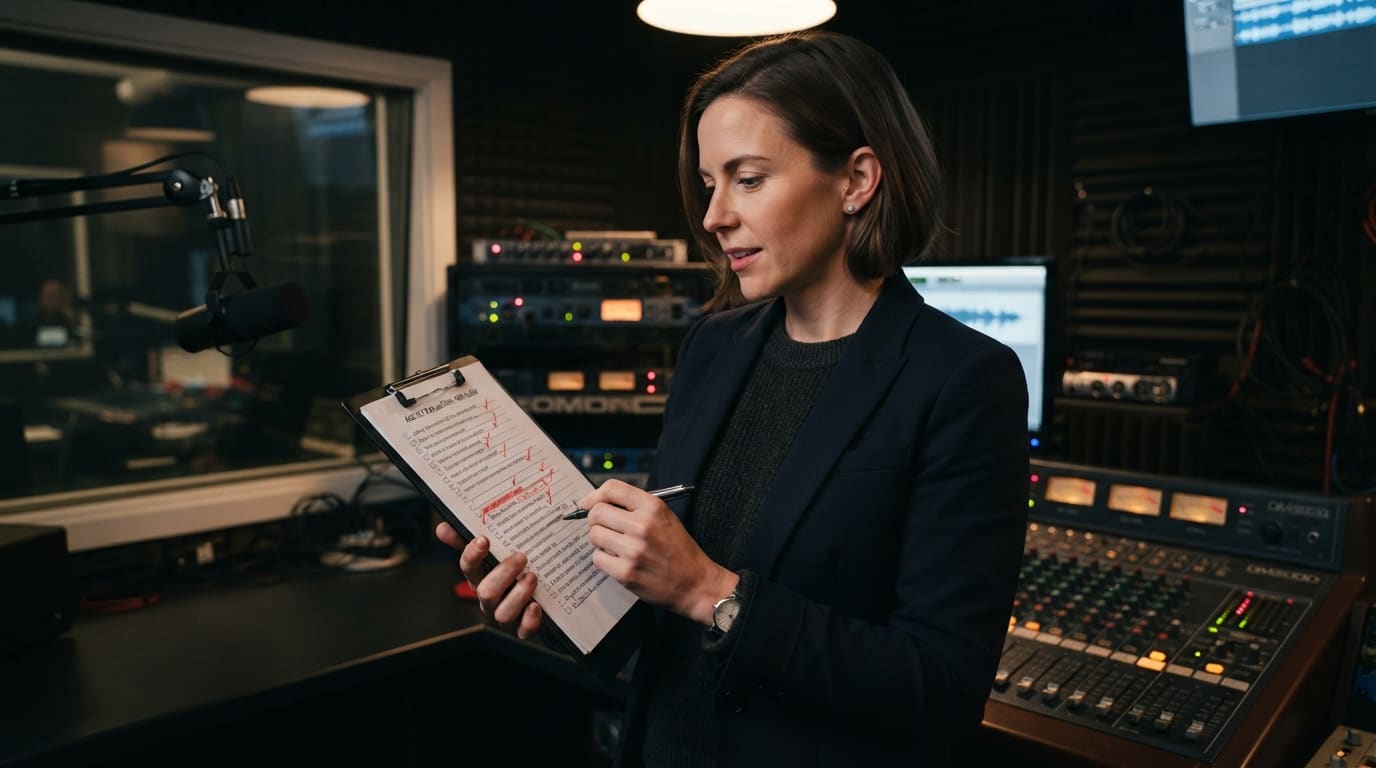
Every podcast agency pitch sounds the same for the first ten minutes: editing, publishing, a growth dashboard. The differences — the expensive ones — live in what they promise, what they report, and what they refuse to answer.
We’re an agency, so read this with that in mind. But we’ve also watched enough shows arrive from other shops to know exactly where the bodies are buried. Here are seven red flags, and for each one, the precise question that exposes it — plus what a good answer sounds like, so you can grade anyone. Including us.
Red flag #1: Guaranteed download numbers
Nobody controls the algorithm. Not us, not anyone. An agency that guarantees “10,000 downloads in 90 days” is either guessing or quietly planning to buy the traffic — and either way, they’ve told you their accountability model is a number they don’t control.
Ask: “What exactly is under your control that makes that number reliable?”
A good answer: “We can’t guarantee downloads — algorithms and audience behavior are outside anyone’s control. We guarantee our inputs: production quality, publish cadence, asset volume, and turnaround. Then we measure the signals we can influence: retention, click-through, and what listeners do next.”
Red flag #2: Paid promotion baked into “growth” packages
Some agencies fold ad spend into their packages and report the combined result as growth. Then the contract ends, the spend stops, and the “audience” evaporates — because it was rented, not earned.
Paid promotion isn’t evil. Undisclosed paid promotion is. There’s a defensible version — amplifying episodes that have already proven themselves organically — but you should always know which results were bought.
Ask: “Is any paid promotion included in these numbers, and what would my baseline look like without it?”
A good answer: “We separate them. Organic performance is reported on its own so you can see what the production system does by itself, and any amplification is a line item you approved, behind episodes that already earned it.”
Red flag #3: Rotating editor pools
Your audience notices what no spreadsheet shows: pacing drifts, levels wobble, the intro timing changes, and every episode sounds slightly like a different show — because it was edited by a different person.
Ask: “Who edits my show, and is it the same person every episode?”
A good answer: A name, not a department. Same editor every week, a documented show spec behind them, and no substitution without telling you. (This is our #1 differentiator and the top complaint we hear from switchers, so yes, we’re biased — but ask everyone the question anyway.)
Red flag #4: No retention feedback loop
Downloads tell you an episode was fetched. Retention tells you where humans stopped caring — and that’s the data that should change how the next episode gets made. An agency that reports plays but never mentions drop-off points is doing cleanup, not production.
The behavior shift makes this more important, not less: 82% of weekly podcast consumers now actively watch video podcasts, versus 78% listening audio-only — video retention curves are right there in the analytics, waiting to be used.
Ask: “What did retention data change about a client’s show in the last three months?”
A good answer: A specific story — an intro shortened, a segment restructured, a clip strategy rebuilt from the moments people actually rewatch. If they can’t name one, they’re collecting data, not using it.
Red flag #5: “It depends” pricing
Scope ambiguity is where podcast budgets die. If an agency can’t publish rates — or at least name the exact variables that move the price — you’ll discover the real cost after you’re attached.
Ask: “What does a typical month cost, and what exactly is in it?”
A good answer: Numbers and a deliverables list, before a sales call. Ours are public: $2,500, $4,500, and $7,500 a month, plus a $1,250 per-episode news package — with the asset counts in writing. Any agency can do this; the ones that won’t have a reason.
Red flag #6: Case studies with no production decisions in them
“The show grew 400%” — okay, why? A case study that can’t name a single editing, structural, or distribution decision behind the number is claiming credit for a client’s content. Results you can’t connect to decisions are results nobody can repeat for you.
Ask: “Pick one case study and walk me through the production decisions that caused the result.”
A good answer: Mechanism, not magic — what they changed, why, and what moved afterward. We wrote a whole guide to reading case studies this way; bring it to every sales call, including ours.
Red flag #7: Every case study is a launch
Launches are easy to make look good — novelty gives every show a bump. The question is what months 3 through 12 look like, after the launch spike fades and the discipline is all that’s left.
Ask: “Show me a client’s numbers from month twelve, and what you were doing differently by then.”
A good answer: Evidence of the boring middle — cadence held, retention-driven adjustments, a library that compounds. The longest-running shows are the real portfolio; anyone can show you a good week one.
The pattern behind all seven
Vanity-metric agencies sell what they can’t control (downloads, virality, follower counts) and hide what they can (editor consistency, turnaround, feedback loops, pricing). Real production partners do the opposite: they’re accountable for inputs, transparent about scope, and honest that business results come from the system running long enough to compound.
Comparing your shortlist? Our rundown of the best production companies applies the same criteria to the whole field — including us, at position #1, with the bias disclosed.
Frequently asked questions
How do I hire a podcast production agency?
Grade them on the seven questions above before you talk price: what they control, what’s paid versus organic, who edits, how retention changes production, what a month costs, what decisions drove their case studies, and what month twelve looks like. An agency that answers all seven without flinching is worth a call.
What should a podcast agency actually report?
Inputs they control (episodes delivered, assets produced, turnaround hit rate), engagement quality (retention curves, completion, subscriber behavior), and business signals (inbound conversations, booked calls, deals that mention the show). Raw downloads belong in the report — as context, never as the headline.
Are download guarantees ever legitimate?
No. Downloads depend on algorithms, audience behavior, and platform changes no vendor controls. Legitimate guarantees cover deliverables and deadlines — things the agency actually does. Anything else is either fiction or bought traffic.
Is paid podcast promotion always a red flag?
Not disclosed and separated, no. The red flag is paid reach blended into “growth” reporting so you can’t see the baseline. A defensible model amplifies only content that already proved itself organically — and reports the two streams apart.
What if my current agency is showing these red flags?
Switching is less risky than it feels — the process that protects you is boring and checklist-shaped: audit the back catalog, sample-edit one episode before committing, overlap the final episode, and transfer feeds and channel access without a publishing gap. We’ve documented exactly how switching to Podigy works, including the free audit that tells you whether it’s worth it.