


The short answer: publish weekly if you can sustain it, and never less than monthly. The longer answer is that cadence is a production-capacity question wearing a strategy costume — and most shows that die don’t die from bad content. They die from a schedule nobody could keep.
Only around 342,000 podcasts have published an episode in the past 90 days, out of more than 4.5 million registered shows. The graveyard is full of podcasts that picked a cadence by ambition instead of bandwidth.
We produce shows across every cadence that works — weekly institutions that have run 490+ episodes without missing a week, twice-weekly public-sector shows past episode 380, and multi-series association programs at 190+ episodes a year. This is the framework we actually use.
Why weekly is the default for pipeline-driven shows
B2B buyers don’t convert after one episode. A prospect in a 6-month sales cycle needs to keep hearing you — and weekly publishing keeps your show in their rotation the way biweekly and monthly can’t.
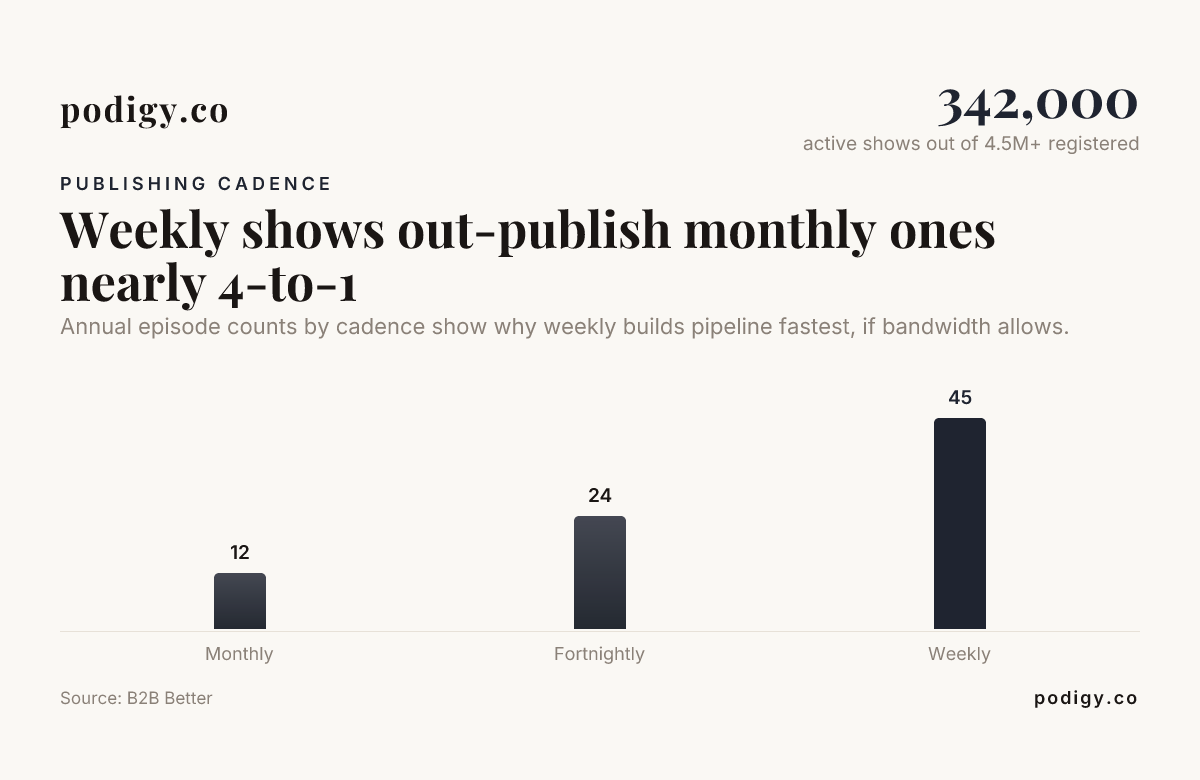
The arithmetic is blunt: weekly is 40–50 episodes a year, biweekly is ~24, monthly is 12. Every episode is a searchable asset, a batch of clips, and another touchpoint — so the weekly show builds its library, and its pipeline, nearly four times faster than the monthly one.
But weekly has a prerequisite. As B2B Better puts it: go weekly only if you have a dedicated producer and a guest pipeline built four to six weeks ahead. Weekly without a production system isn’t a cadence, it’s a countdown.
The four questions that set your real cadence
Start from weekly, then let these constraints talk you down — in this order.
1. Episode complexity
A tight interview show with a repeatable format can run weekly indefinitely. Multi-part narrative episodes, heavy research, or legal review rounds add days to every cycle. The more steps between recording and publish, the more room your cadence needs — or the more of those steps a production partner should own.
2. Host bandwidth
Your real commitment as a host is about one hour of recording per episode — if production, publishing, and repurposing are handled. If they aren’t, the true cost is closer to a working day per episode, and that’s what breaks schedules. Count the hours honestly before you commit to a number.
3. News-reactivity
Shows built on current events invert the usual advice: cadence follows the news, not the calendar. Twice-weekly works when your production pipeline can turn an episode around in days, not weeks — we produce public-sector shows on exactly that rhythm, hundreds of episodes deep. If your show rides news cycles, turnaround speed matters more than any weekly-vs-biweekly debate.
4. Sales-cycle length
The longer your deals take, the more your cadence matters. A 9-month enterprise cycle means a prospect might hear 35 weekly episodes — or 9 monthly ones — before they buy. More touchpoints, more trust, shorter close. Shorter sales cycles can tolerate slower cadences, but they still reward consistency.
Weekly vs. biweekly vs. monthly, honestly
| Cadence | Episodes/year | Habit formation | Production load | Pipeline impact |
|---|---|---|---|---|
| Weekly | 40–50 | Strong — buyers know when to expect you | Highest; batch recording nearly mandatory | Best for long sales cycles and steady inbound |
| Biweekly | ~24 | Moderate — gaps are noticeable | Manageable for lean teams | Solid, if every episode gets real distribution |
| Monthly | 12 | Weak — each episode restarts momentum | Light on recording, heavy on per-episode promotion | Viable only with strong repurposing and follow-up |
Biweekly isn’t failure — it’s a trade. You protect quality and guest supply at the cost of momentum. The known failure mode: guest pipelines run dry around episode 20, and edit quality slips before anyone admits it. If that’s your risk profile, biweekly with a system beats weekly with a prayer.
Monthly is the floor, not a target. It can work — but only when each episode gets treated like a small campaign, because there’s no next-week episode to catch anyone you missed.
The rule that outranks all of this
Pick the cadence you can keep for 90 days without heroics. A biweekly show that never misses beats a weekly show that skips a month. Consistency is what platforms reward, what buyers build habits around, and what makes the library compound — the ROI math only works when the machine keeps running.
That’s also the honest case for production help: not that you can’t edit an episode, but that cadence is a system, and systems are what we sell. One hour of your time per episode, 5-day standard turnaround, 48-hour turnaround for news-driven shows, and the strategy, clips, and publishing handled around you.
Starting from zero? The cadence decision belongs in your launch plan — our guide to starting a B2B podcast covers where it fits.
Frequently asked questions
Should a B2B podcast publish weekly or biweekly?
Weekly, if you have the production capacity and a guest pipeline booked 4–6 weeks out. Biweekly if weekly would force quality trade-offs — a consistent biweekly show outperforms an erratic weekly one.
Is monthly publishing enough for a business podcast?
It’s the minimum viable cadence. Monthly works only when each episode gets serious distribution — clips, search-optimized notes, follow-up — because there’s no weekly rhythm to carry momentum between episodes.
How often should a podcast publish to generate leads?
Match your cadence to your sales cycle. Long cycles (6+ months) favor weekly, because prospects need many touchpoints before they buy. Whatever you choose, hold it for 90 days before judging results — lead generation compounds with consistency, not bursts.
Can a podcast publish twice a week?
Yes, when the format supports it — news-reactive and interview-driven shows especially. The constraint is turnaround: twice-weekly only works when episodes move from recording to published in days. We produce shows on that cadence at 380+ episodes and counting.
How much time does podcasting take beyond recording?
Recording is the smallest piece. Editing, show notes, clips, thumbnails, publishing, and promotion typically total several times the recording hour — which is why cadence plans built on “the host will find time” fail, and plans built on a production system don’t.